Welcome to Tangshan Moneide Trading Co., Ltd.






Moneide Chemicals
Tel: 86-315-8309571
WhatsApp/WeChat/Mobile: 0086-15633399667
Skype: janet-honest
Mail: sales@moneidechem.com
Address: 2-7-523 Jidong Building Materials Tangshan, Hebei 064000 China
|
Chemical Name |
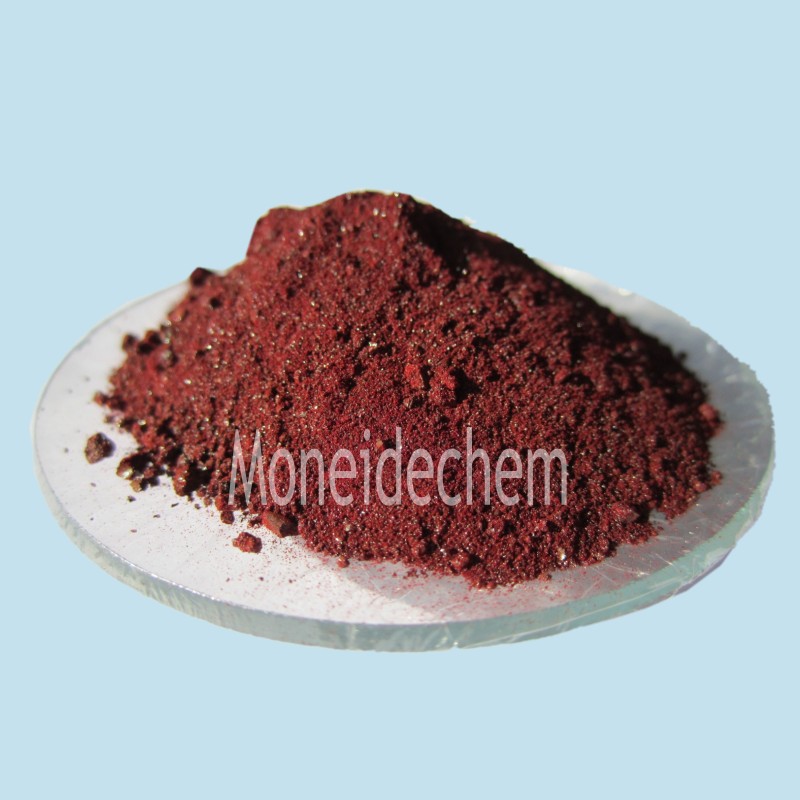
Xylenol orange tetrasodium salt |
|
CAS No. |
3618-43-7 |
|
Molecular formula |
C31H28N2Na4O13S |
|
EINECS No. |
222-805-8 |
|
Molecular weight |
760.58 |
|
Molecular Structure |
|
|
Details |
Appearance: reddish brown crystal powder Solubility in water: Passes test Sensitivity test: Passes test Sulfated ash: 30%~35% Loss on drying: 15% max Solubility: easy deliquescence, solve in water, insolve in alcohol Packing: 25kg/ fibre drum |
|
Main Application |
Indicator |

What is Xylenol orange Tetrasodium salt used for?
Xylenol orange tetrasodium salt is primarily used as a metallochromic indicator in complexometric titrations, particularly for detecting metal ions like zirconium, thorium, and rare earth elements. The tetrasodium form offers enhanced water solubility compared to the free acid, making it ideal for preparing stable analytical solutions. It serves as a key reagent in spectrophotometric determination of various metals in environmental and industrial samples. The compound's high sensitivity allows detection of trace metal concentrations in water quality testing and metallurgical analysis. Its applications extend to histological staining where metal ion distribution needs visualization.
What is the xylenol orange indicator used for?
Xylenol orange indicator is widely employed as an endpoint detector in EDTA titrations of numerous metal ions. It finds particular utility in determining water hardness by complexing calcium and magnesium ions. The indicator's distinct color change facilitates visual titration of aluminum, bismuth, and lead in pharmaceutical quality control. Researchers use it in zymography to detect enzyme activity involving metal ions. Its ability to form colored complexes with over 30 metals makes it invaluable in analytical chemistry for both qualitative and quantitative metal ion analysis across various sample matrices.
Why does xylenol orange change color?
Xylenol orange changes color due to structural rearrangement when complexing with metal ions. The free indicator appears yellow in acidic solution, transitioning to red when bound to metals. This chromogenic response stems from the compound's sulfonephthalein structure altering its electron delocalization upon metal coordination. The nitrogen and oxygen donor atoms in its molecular framework create a binding pocket that distorts the conjugated π-system when metals chelate, modifying light absorption properties. The intensity of the resulting red color directly correlates with metal ion concentration, enabling quantitative spectrophotometric analysis.







Moneide Chemicals


